Showers
Walls and floor, with the waterproofing doing the work underneath. Our Silver Lake shower runs 4×4 rouge zellige over a Schluter Kerdi system, with a piece of the same zellige set into the drain grate.
 CONTACT
Handmade Moroccan zellige installed across Los Angeles: showers, backsplashes, bars, fireplace hearths and powder rooms, set tight with the owner on site.

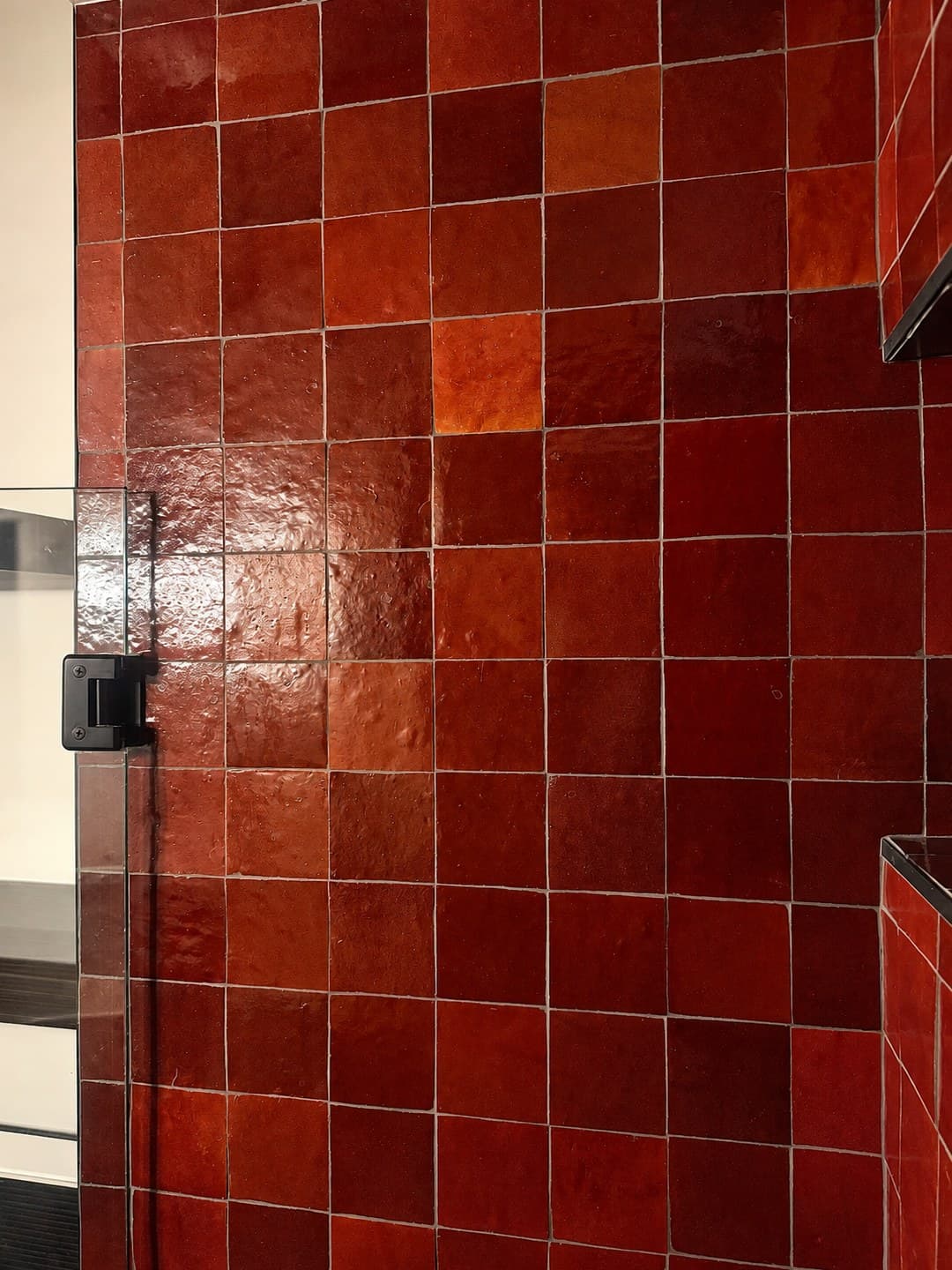
Zellige is glazed clay tile made by hand in Morocco. Every piece is shaped, glazed and fired by hand, so the faces are waved, the edges are slightly out of square and the glaze pools and thins differently on every tile. Set them side by side on a wall and the light breaks across it unevenly. That movement is what people are paying for, and it is why a zellige wall never reads as flat color.
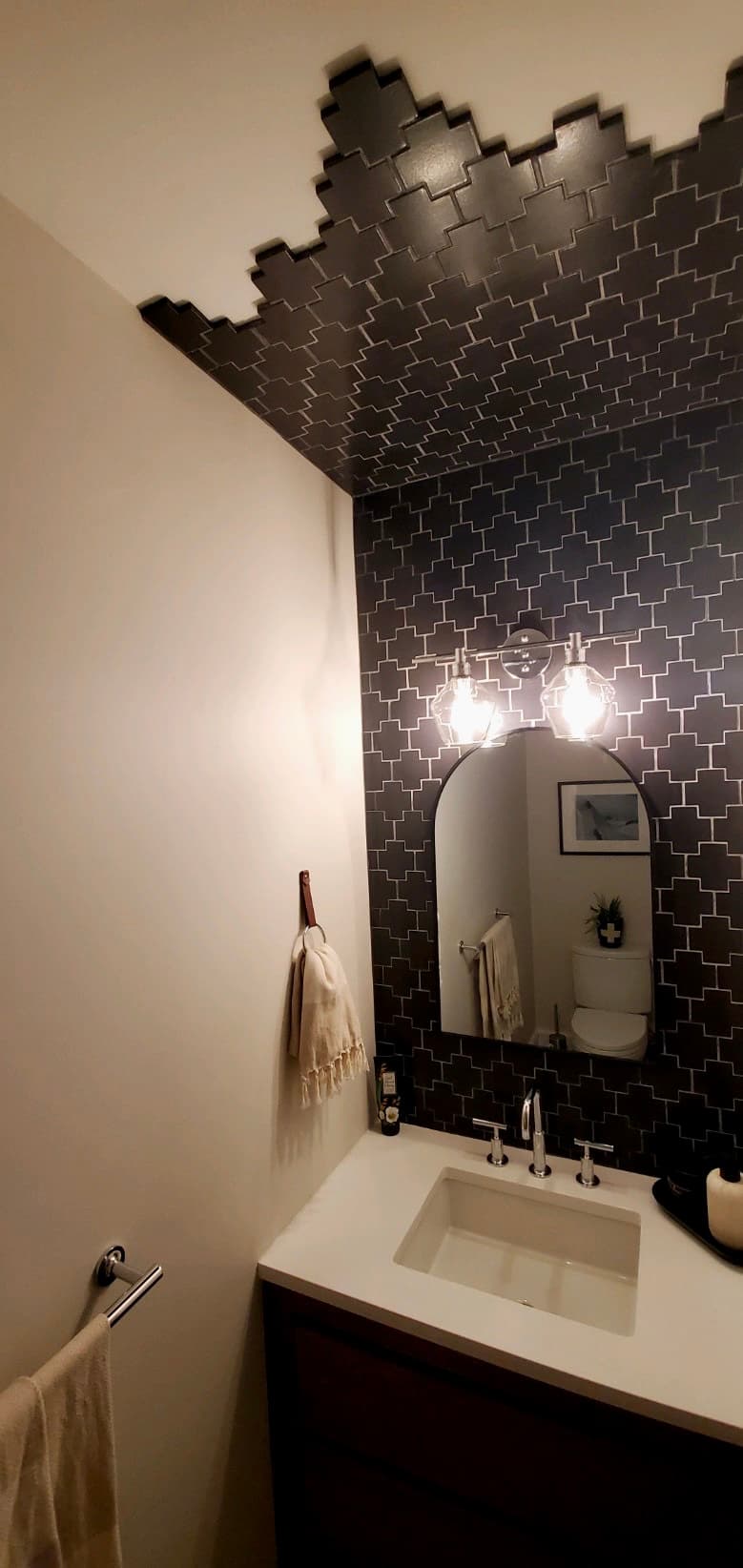
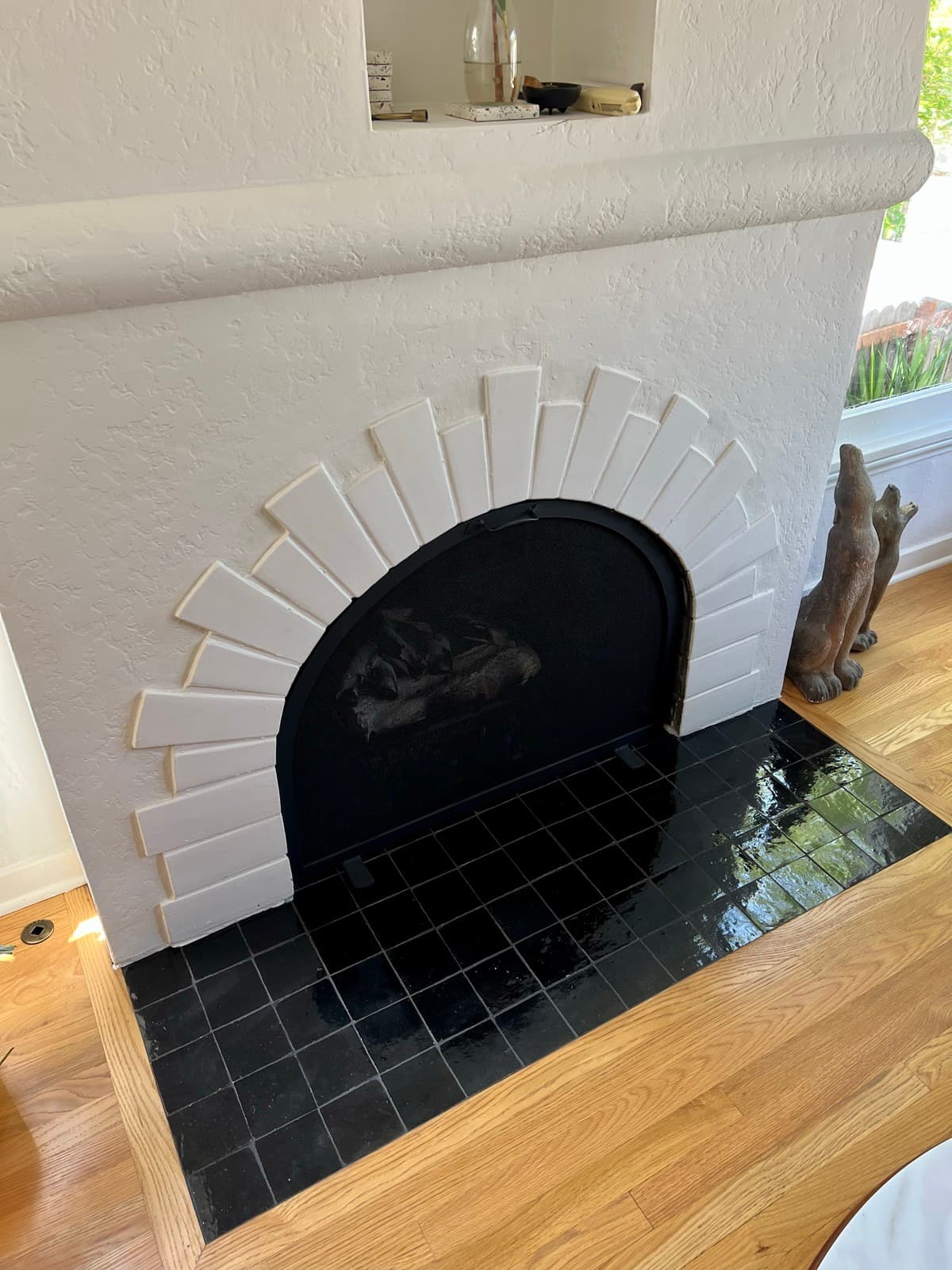
Squares are the classic look, set almost butted together, but zellige also comes as 2×6 rectangles called bejmat, hexagons, trapezoids and patterned mosaics, glazed and glossy or unglazed and matte. We have set copper and brown 2×2 behind a Glassell Park bar, black 4×4 on a Highland Park hearth, and 4×4 rouge through an entire Silver Lake shower. Shaped pieces change the character again, like the dark cross pattern in this powder room climbing the wall onto the ceiling. Grout is the quiet last choice: close to the tile color, the wall reads as one surface; in contrast, it draws the grid.
Zellige punishes an installer who treats it like ceramic. The substrate has to be flat before the first tile goes on, because the tile's own variation is all the movement the wall can take. Every tile gets full mortar coverage, on the substrate and on the back of the tile. We set it tight, often a 1/16-inch joint or close to butted, and blend from several boxes at once so a dark batch doesn't stack in one corner.
Zellige earns its place anywhere people look closely. These are the places we set it most, and what each one asks of the install.
Walls and floor, with the waterproofing doing the work underneath. Our Silver Lake shower runs 4×4 rouge zellige over a Schluter Kerdi system, with a piece of the same zellige set into the drain grate.
A vertical surface at eye level, where the glaze gets seen up close and nothing walks on it. The Glassell Park bar is 2×2 zellige behind floating oak shelves and wine racks.
A hearth takes feet, fire tools and firewood. The Highland Park hearth went down over self-leveler with epoxy grout, and every raised edge was polished back for a toddler just learning to walk.
Small rooms are where zellige can go all the way: floor to ceiling, or up the wall and across the ceiling. Less area means you can choose a bolder color or shape without it overwhelming the house.
Handmade tile shifts between production runs, and a reorder placed after demo will not match the wall already started. We help you get the quantity right before anything ships.
The tile brings its own variation. The wall behind it can't add more, so the substrate gets leveled and trued before the first piece is set.
Trim or miter, black metal or the tile itself, gets settled at the walkthrough, not improvised at the last corner. All of our work is warrantied.
“Corey has done several tile jobs for us at our home. We met with several tile installers and Corey was easily the best fit. Timely, transparent communication, work completed on schedule, very fair prices. We were thrilled with how his interior and exterior tile jobs turned out. Give him a call. He does great work.”
The questions people actually ask before they hire us, and the technical detail behind how we build. Open whichever ones matter to you.
Zellige is a clay tile made by hand in Morocco, a craft with centuries of history behind it. Each piece is hand-shaped and kiln-fired, most of it under a glossy glaze, so the faces are uneven, the edges are slightly out of square, and the color shifts from tile to tile. Chips, pits and fine crazing in the glaze come with it. That irregularity is not a flaw in the product. It is the reason the finished wall has depth that machine-made tile doesn't.
It depends on the surface and the budget. Machine-made ceramic and porcelain "zellige look" tiles are consistent in size and thickness, so they go in faster and cost less to install, and some are made for floors. Real zellige has glaze depth and variation a printed or molded tile can't fully copy, and it takes more labor to set well. We install both, and we'll tell you honestly which one suits the room you're doing.
Yes. The tile isn't what keeps a shower dry; the waterproofing system under it is. On our Silver Lake shower we ran 4×4 rouge zellige on the walls and the floor over a Schluter Kerdi system, set in Schluter ALL-SET, with a Schluter tileable drain grate holding a piece of the same zellige so the floor reads unbroken see the project.
Yes, with care. Glazed zellige can go on floors, shower floors included, as long as the maker's slip guidance is followed, because the glaze is slick when wet. Zia Tile's own guidance is to use smaller formats like 2×2 on a shower floor, because more grout lines mean more grip, to add a slip-resistant coating on larger sizes like 4×4, and to open floor joints to at least 1/8 inch.
It is also softer than porcelain, so edges can chip under heavy impact. A hearth, a powder room or a shower floor is a good fit; a busy kitchen or an entry that takes everything from the street is a harder ask. If a floor isn't right for the zellige you love, we'll say so before you buy it.
It depends on the job. On the Highland Park hearth we used SpectraLOCK Pro Premium epoxy grout for crack and stain resistance, because the joints were as tight as the tile allowed and a thin joint needs all the strength it can get see the project. In the Silver Lake shower we used Laticrete Permacolor in Raven see the project.
Color matters as much as type. Grout close to the tile color lets the wall read as one surface; a contrasting grout draws the grid and makes every irregular edge visible. We decide it with a sample against your actual tile.
On walls, tight: we often set zellige at a 1/16-inch joint or close to butted, which is the traditional look and what Zia Tile recommends. For floors, Zia recommends a wider joint of at least 1/8 inch, for grip and to take up movement. Because every tile is a slightly different size, the joints are read and adjusted by eye rather than set with spacers, and we blend from several boxes at once so a dark batch doesn't stack in one corner.
Because they are handmade. Chips at the edges, pits in the glaze, uneven faces and shade changes are all normal for zellige, and they are what make the wall look like zellige. The installer's job is to make that variation read as intentional rather than sloppy. Where a raised edge sits somewhere hands or feet will find it, we polish it back, as we did on a Highland Park hearth for a family with a toddler see the project.
More than a square-footage calculator tells you, and all of it at once. Zia Tile recommends at least 15 percent over your measured area, and 20 to 25 percent if you want to pull out the most chipped or irregular pieces, since they expect roughly 15 to 20 percent of zellige to carry visible imperfections. Pattern layouts and diagonal cuts eat more on top of that. Handmade tile also shifts between production runs, so a second order months later is unlikely to match the first. Talk to us before you order and we'll help you size it for your actual layout.
It depends on the finish and the room. The glaze itself is waterproof, so glazed zellige on a dry backsplash or fireplace doesn't need it. In a shower or anywhere else that stays wet, Zia Tile's guidance is to seal the tile and grout with a penetrating sealer once grouting is done, and to reseal every one to two years.
Unglazed natural zellige is porous clay and is sealed before it is grouted, then finished with a matte wax, because a stain on unsealed natural zellige can be permanent. Either way we follow the maker's instructions for the exact tile you've chosen.
There are three ways, and it gets decided at the walkthrough. The cleanest is to avoid an exposed edge at all: run the tile to the ceiling, or bring the drywall flush with the face of the tile. Where an edge can't be avoided, it gets mitered at 45 degrees or finished with a metal trim. In the Silver Lake shower we used black Schluter trim, because the rest of the bathroom already had black paint and black hardware and the trim protects the edges of a handmade tile see the project. Mitering keeps the tile as the only material you see, as on the handmade tile in our Pasadena bathroom see the project, but it is slower and costs more in labor.
We have sourced zellige from Zia Tile in Los Angeles for a Highland Park hearth and a Silver Lake shower; they stock a large range of shapes and colors in both glazed and unglazed finishes. Plenty of our clients buy their own and have us install it. If you're buying it yourself, talk to us before you order: we'll help with quantity, and we'd rather flag a tile that won't suit the surface before it's paid for.
Yes. Thickness varies tile to tile and faces are waved, so lippage is a feature of the material, not a mistake, and any installer who promises you a dead-flat zellige wall either hasn't set it or is about to grind the edges off it. It takes longer to set than a machine-made tile, and it is worth hiring someone who has done it before.
We're based in Northeast Los Angeles and generally work within about 50 miles: Highland Park, Eagle Rock, Glassell Park, Mount Washington, Atwater Village, Silver Lake, Los Feliz, and Echo Park close to home, then Pasadena, South Pasadena, Altadena, Sierra Madre, San Marino, Alhambra, Monrovia, and Arcadia to the east, and Glendale and Burbank to the north. We also head out west as far as Malibu for the right project. If you're near the edge of that radius, ask. We'd rather tell you yes or no on the phone than have you guess.
Tell us about the project. We respond to most inquiries within a day, and Corey reads every message himself.


